
Dubai’s healthcare system operates under a three-tiered regulatory framework, with the Dubai Health Authority (DHA) at its core. The DHA oversees 1,500+ healthcare facilities, while Sheikh Mohammed bin Rashid Al Maktoum sets strategic direction. Operational execution is coordinated through Dubai Municipality and Dubai Health Corporation, ensuring seamless governance.
The system is funded through a mixed-financing model: private employers contribute 48%, government sources account for 39%, and out-of-pocket spending makes up 13%. With AED 118 billion in planned investments through 2027, Dubai’s healthcare governance emphasizes compliance, quality, and innovation.
The Three-Tiered Regulatory Framework
Dubai’s Public Health Law No. (5) of 2025 introduced a robust three-tier system:
1. Dubai Health Authority (DHA): Licensing, facility oversight, patient safety, and digital health initiatives in Dubai mainland.
2. Dubai Healthcare City Authority (DHCA): Autonomous regulation of Healthcare City free zone facilities.
3. Ministry of Health and Prevention (MOHAP): Federal oversight of pharmaceutical control, accreditation standards, and cross-emirate policies.
The law mandates disease prevention, reporting, and compliance, with fines up to AED 1 million for violations. It also aligns Dubai’s local regulations with federal laws, ensuring uniform healthcare standards across all zones.
Power Distribution Among Authorities

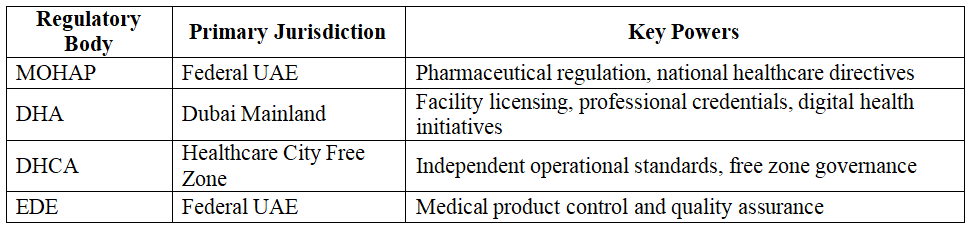
- DHA: Central authority for facility licensing, professional credentialing, and patient data management (9.5 million records unified).
- DHCA: Free zone regulator with independent operational standards.
- MOHAP: Federal policies, accreditation, and smart auditing for engineering and facility compliance.
Licensing Example: Healthcare professionals must pass DHA Prometric exams to practice in Dubai mainland, while DHCA manages its own licensing within its free zone.
Leadership & Key Decision Makers
Dubai’s healthcare system is guided by strategic leadership at multiple levels:
- Sheikh Mohammed bin Rashid Al Maktoum: Sets strategic vision.
- Sheikh Hamdan bin Mohammed bin Rashid Al Maktoum: Supervises sector reforms.
- DHA Director General Awadh Al Ketbi & Dubai Health CEO Dr. Amer Sharif: Operational execution, digital transformation, and public-private partnerships.
The leadership oversees AED 5.745 billion in healthcare budgets and implements integrated physician practice models to enhance patient care.
Core Regulatory Power Structure
Public-Private Partnership Governance
Dubai’s healthcare relies on coordinated public-private collaboration:
- Private employers fund 48% of healthcare, government covers 39%, out-of-pocket spending is 13%.
- DHA coordinates standards while private hospitals improve efficiency and reduce wait times.
- Initiatives like EJADA and mandatory insurance ensure equitable access while promoting innovation.
Financial Control & Investment Oversight
Dubai’s healthcare finances are carefully regulated:
- Private sector contribution: 48%
- Government funding: 39%
- Out-of-pocket: 13%
- Projected infrastructure & digital investments: AED 118 billion (2023–2027)
- Growth rate: Private healthcare expenditure CAGR 9.3%, public sector 7.7%
The DHA enforces IFRS-compliant reporting, audit oversight, and penalties for mismanagement, ensuring transparency and fiscal responsibility.
Legal Enforcement & Compliance
Public Health Law No. (5) of 2025 outlines strict compliance mechanisms:
- Regular inspections with penalties up to license suspension.
- Monitoring of clinical standards, patient safety, and professional conduct.
- Digital audits to enforce data security and privacy.
- Formal appeal processes through independent committees.
Non-compliance may result in fines, operational suspension, or exclusion from national health platforms.
Strategic Vision & Implementation

Dubai aims to be a global healthcare hub, guided by a people-first, preventive care strategy:
- DHA: Regulates providers and insurers.
- Dubai Health: Manages public facilities using integrated physician practice models.
- MOHAP: Oversees federal projects and policy alignment.
- EHS: Operates select Dubai facilities.
Focus areas include digital transformation, quality improvement, sustainability, and international benchmarking.
Frequently Asked Question
1. How can patients appeal medical decisions?
Through DHA or MOHAP digital portals, patients can escalate to independent medical review committees or healthcare tribunals under Law No. (5).
2. What is the role of international healthcare organizations?
They provide specialist expertise, establish centers of excellence, transfer technology, and support research and training, aligning with global standards.
3. Can residents choose between public and private facilities?
Yes, choice depends on insurance coverage. Public hospitals charge more for expatriates, while private hospitals offer premium services.
4. How are medical malpractice disputes resolved?
Internal hospital complaints escalate to DHA’s Medical Liability Committee; private mediation or arbitration is optional, with legal action via Dubai Courts as a final step.
5. What happens if providers fail digital transformation requirements?
Non-compliance risks license suspension, fines, exclusion from NABIDH, loss of insurance payments, and potential legal prosecution under UAE Health Data Law.