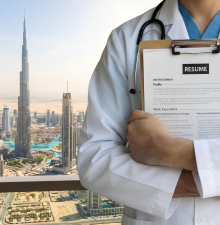
Explore how Dubai’s healthcare system outperforms other Gulf countries in 2025. Discover digital innovation, medical tourism, infrastructure, insurance, and quality metrics.
Overview: Dubai Healthcare vs. Gulf Peers
Dubai’s healthcare system leads the Gulf region in 2025, investing AED 118 billion in infrastructure and digital transformation. AI-powered facilities reduce diagnostic errors by 40% and cut treatment wait times by 50%, attracting 691,478 medical tourists annually. Strict regulations, including Law No. (5) of 2025, and insurance plans starting at AED 320 set new regional standards. Dubai’s integrated approach establishes it as a Gulf healthcare leader.
Healthcare Spending and Economic Impact
Dubai’s healthcare funding balances public and private contributions, with 48% from employers and 39% from government spending. The UAE’s AED 5.745 billion federal allocation demonstrates commitment to quality care, but rising costs—especially in mental health—pose financial pressures.
Key points:
Dubai healthcare spending grew 4% (2022-2023); out-of-pocket costs increased 3%
Projected regional cost growth of 12%, the highest globally
AED 118 billion investment target by 2027 aims to expand infrastructure and digital services
Dubai’s healthcare affordability remains a focus, balancing high-quality care with cost management.
Digital Innovation and Technology Leadership

Digital healthcare drives Dubai’s regional advantage:
- AI-driven predictive analytics and telehealth reduce consultation times 15%
- Voice of Customer platform streamlines patient experience
- Hayat program and AI-powered audits enhance data security and compliance
- Center for Technology and Innovation promotes research-to-practice integration
Dubai’s commitment to multidisciplinary collaboration ensures continuous innovation, improving patient outcomes and positioning the emirate as the Gulf’s healthcare technology leader.
Infrastructure Development and Facility Standards
Dubai’s healthcare expansion focuses on strategic facility placement and advanced technology integration:
- Construction of 3 hospitals and 33 primary health centers (PHCs) by 2033
- AI-driven and robotic medicine centers aligned with UAE 2030 strategy
- Specialized medical hubs for advanced care and medical tourism
- Telehealth expansion enabling 65% virtual consultations by 2025
- Green technology initiatives enhance sustainability
With over 150 hospitals and 5,000 healthcare facilities, Dubai ensures world-class facility standards compliant with DHA regulations.
Regulatory Excellence and Policy Frameworks
Law No. (5) of 2025 strengthens Dubai’s healthcare governance:
- Mandatory employer-sponsored insurance starting at AED 320/year
- Penalties up to AED 500,000 for non-compliance
- Integration of federal and emirate-level public health measures
- Tiered insurance, co-pay caps, and preventive care incentives
- Real-time digital compliance monitoring by DHA
Dubai’s regulatory frameworks exceed other Gulf nations in scope, enforcement, and domestic worker protections, ensuring accessible, high-quality care for residents.
Medical Tourism and Regional Competitiveness
Dubai’s medical tourism sector thrives due to advanced infrastructure and patient experience optimization:
- 691,478 medical tourists in 2023 (2.6% increase from 2022)
- Projected USD 7.5 billion market value by 2026
- Dubai Healthcare City centralizes international providers and specialized care
- 85% of patients choose Dubai for AI diagnostics and robotic surgeries
- Multicultural medical staff serves diverse populations (37% Asian, 31% Arab, 15% European)
Dubai’s patient-focused ecosystem outperforms regional competitors through integrated tech, international standards, and tourist-friendly facilities.
Public-Private Partnership (PPP) Models
Dubai’s healthcare PPPs demonstrate advanced integration and innovation:
- Private spending grows 9.5% annually, public 4.4%
- Long-term joint facility management (10+ year agreements)
- AI diagnostics, blockchain data systems, and telemedicine platforms generate innovative revenue streams
- New PPP projects: three specialist hospitals with 1,200 beds
Investment flows highlight Dubai’s tech-focused approach vs. Saudi Arabia’s infrastructure-centric model:
Sector | Dubai | Saudi Arabia |
Specialized Hospitals | AED 15B | EOIs for Al-Ansar |
Smart City Healthcare | AED 30B | Limited tech focus |
Private Spending Growth | 9.5% | 4.4% |
Risk-sharing digital initiatives further transform healthcare delivery, creating collaborative models that exceed traditional Gulf approaches.
Healthcare Quality Metrics and Patient Outcomes
Dubai achieves outstanding healthcare outcomes compared to Gulf peers:
- 208 JCI-certified facilities ensure standardized care
- Advanced surgical tech (Da Vinci systems) reduces mortality rates
- Integrated health records and AI analytics reduce errors by 30%
- Life expectancy reaches 80 years, with telehealth expanding specialty access
Key performance metrics (2025)
Metric | Dubai | Gulf Avg |
Telehealth Adoption | 65% | 45% |
Digital Record Accuracy | 98% | 82% |
AI Diagnostic Success | 92% | 76% |
Patient Portal Usage | 85% | 58% |
Remote Monitoring | 78% | 51% |
Dubai’s digital platforms and AI adoption position it as the Gulf leader in healthcare quality and technology integration.
Regional Rankings and Achievements
- Top 10 globally in 21 health indicators
- Leads GCC in internationally accredited facilities
- 4 hospitals among world’s top 250 academic medical centers
- Highest regional standards in preventive care and specialized treatment access
Dubai outperforms regional competitors like Saudi Arabia, Qatar, Kuwait, and Oman in technology adoption, patient outcomes, and medical tourism readiness.
Frequently Asked Questions
1. How do specialist wait times compare across Gulf countries?
Private clinics in Dubai offer same- or next-day appointments, while public facilities can take several weeks. Telemedicine is improving wait times region-wide.
2. What is the local vs. expatriate healthcare workforce ratio?
Expatriates remain the majority, with 904,646 new registrations in 2023. Dubai is increasing local participation, particularly in nursing.
3. How fast are emergency response times in Dubai?
Police: 2.41 minutes, ambulances: 7.5 minutes, fire: 4 minutes, surpassing global benchmarks.
4. How does Dubai’s mental health care compare?
Dubai leads the Gulf in mental health services, offering therapies like rTMS and VR, with growing acceptance despite high costs and limited insurance coverage.
5. How do medication costs and regulations vary across the Gulf?
UAE provides broader access through advanced distribution, Saudi Arabia uses lowest-price models, and Qatar emphasizes innovation-focused pricing, while GCC nations maintain unified drug registration systems.